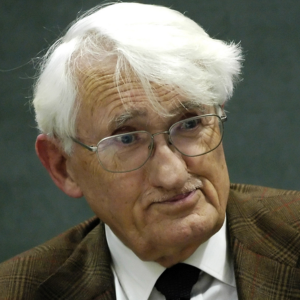
Jürgen Habermas
Jürgen Habermas was one of the most influential contemporary thinkers in philosophy and social theory, particularly associated with the Frankfurt School tradition.
Born in 1929, Habermas came of age in the aftermath of World War II, an experience that deeply shaped his intellectual focus on democracy, communication, and the public sphere. He studied philosophy, history, and psychology at universities in Göttingen, Zurich, and Bonn.
Habermas first gained prominence with his 1962 work, The Structural Transformation of the Public Sphere, in which he examined how public debate and democratic participation evolved in Europe. He later developed his most famous theoretical framework in The Theory of Communicative Action, arguing that rational communication and dialogue are the foundation of a just and democratic society.
Throughout his career, Habermas has focused on themes such as deliberative democracy, ethics, law, and the role of reason in modern societies. His concept of the “public sphere” has become central to discussions in political science, media studies, and sociology. He has also been an active public intellectual, frequently contributing to debates on European integration, human rights, and globalization.
Habermas taught at several institutions, most notably the University of Frankfurt, and has received numerous international awards for his contributions to philosophy and social thought. Even in his later years, he has remained an important voice in discussions about democracy and the future of Europe.